
How Taxes and Sentiment Lock Up Your Portfolio
The Two Things Keeping You Concentrated
Behavioral instinct and tax deferral both push portfolios toward concentration, often unintentionally.
Here’s a pattern we see often: a taxable account built around several large, long-held positions, or a single stock. You may be reluctant to sell, sometimes because you’ve grown attached to the position, sometimes because deferring the tax is genuinely the smart move in a given year. Both are valid decisions. The problem starts when the emotional pull, or the tax deferral, stops being a deliberate choice and becomes the default that quietly runs the whole portfolio.
How portfolios end up overly concentrated
Tax deferral
A quick definition: an SMA, or separately managed account, holds individual stocks in your name rather than pooling them into a fund. Direct indexing is an SMA built to track an index, like the S&P 500, by owning the individual stocks. These strategies gained popularity as a way to manage tax liability: by holding individual securities, an advisor can sell positions with losses and use those losses to offset gains elsewhere in the portfolio. In a long bull market, like the one we’ve been in, most positions turn into winners. There are fewer and fewer losers left to harvest. Eventually almost everything in the account has a large embedded gain, and any trade of real size means realizing that gain and paying the tax. At that point the account stops behaving like an actively managed portfolio and starts behaving like a fixed collection of whatever happened to be winning when the losses ran out, “ossified,” in the sense that it’s gone from something living and adjustable to something rigid. The tool built to manage taxes and concentration ends up frozen in the concentration it was supposed to manage.
Behavioral attachment
Tax isn’t always the reason you won’t sell. Sometimes the position came from a former employer, years of loyalty turned into equity. Sometimes it’s the one holding that’s made real money, and trimming it feels like betting against a winning streak. Sometimes it’s inherited, and selling feels like selling a piece of whoever left it to you.
Ask anyone who’s priced out their childhood home or tried to sell a piece of furniture that’s been in the family for decades. The number a buyer offers almost never matches what the thing is worth to the person selling it. Behavioral finance has a name for that gap: the endowment effect, our tendency to value what we own more than we’d ever pay to acquire it fresh. A concentrated stock position behaves the same way once it’s carrying a story, a former employer, an inheritance, the one bet that paid off. It stops pricing like an asset and starts pricing like a keepsake.
The concentration is real, and it’s historic
This is fairly well-telegraphed, but a small number of very large companies now make up an unusually large share of the US market. As a result, many portfolios, especially those tracking or overlapping with the S&P 500, are carrying more single-name risk than their owners think.
~41.0% – Share of S&P 500 index weight held by the top 10 stocks, a record, roughly double the 2015 level, and well ahead of their ~32% share of index earnings.
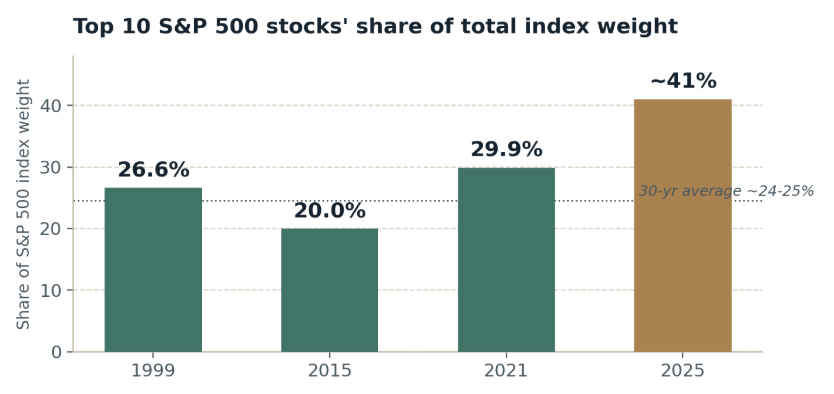
Source: S&P Dow Jones Indices; Goldman Sachs Global Investment Research.
Here’s what that looks like in an actual account. Say NVDA has grown into representing 15.0% of your portfolio. Another 30% of your portfolio is invested in VOO, a fund that tracks the S&P 500. The VOO sleeve looks like the diversified part of the portfolio. But NVDA alone makes up roughly 7.8% of the S&P 500 right now, so VOO is quietly contributing another 2.3 percentage points of NVDA exposure. Add that to the direct position, and your real NVDA exposure is 17.3% of the portfolio, not the 15% you think you’re tracking.
NVDA look-through exposure
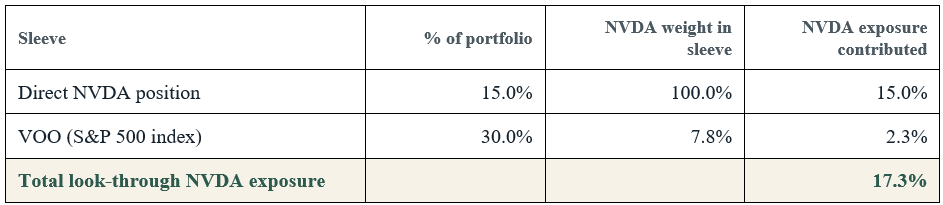 Illustrative example. NVDA’s actual index weight moves and should be confirmed at the time of the conversation.
It’s not just single names. Geography is concentrated too.
Most US investors hold 70 to 80% of their equity portfolio at home, even though the US is roughly 62% of the MSCI All Country World Index. In the last year and a half, the cost of that home bias was real. It was just obscured by strong performance almost everywhere.
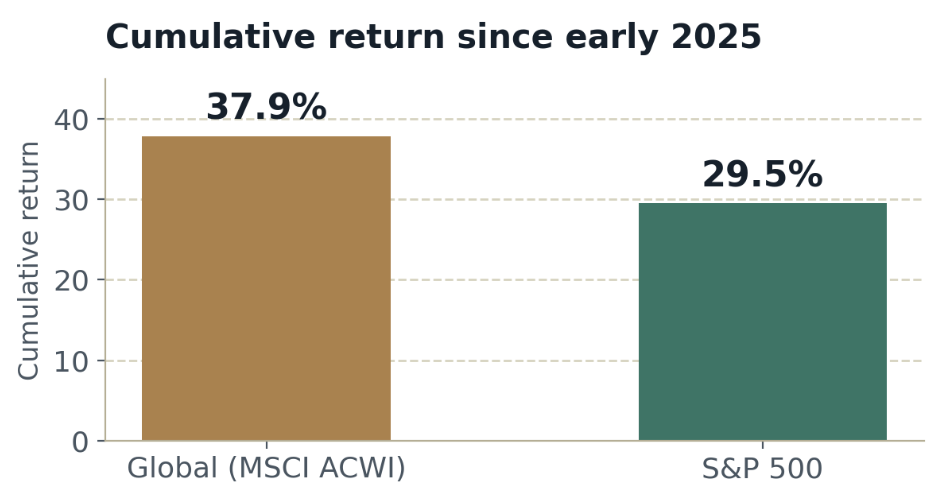
MSCI ACWI and S&P 500 total returns, December 31, 2024 through September 30, 2026 (Kwanti).
While the globally diversified index outperformed, the S&P 500 still made real money. Specifically, a $500,000 account that tracked only the S&P 500 over the last year and a half grew to roughly $647,500. The same $500,000, invested in a globally diversified portfolio, grew to approximately $689,500. That $42,000 gap is the real cost of staying US-only. It didn’t show up as a loss, so it was easy to miss.
We need to reframe how we talk and think about taxes
Say you put $10,000 into a stock five years ago. It’s done phenomenally well: the position is now worth $50,000, a $40,000 gain! Somewhere along the way, our instinct shifted to describe this as “I owe $8,000 in taxes if I sell.” It’s more accurate, and more useful, to describe it as “I just made $32,000, after tax.” That’s not a glass half full. At a 20% capital gains tax rate, it’s a glass four-fifths full.
After-tax outcome on that $40,000 gain, today
| Scenario | Rate | Tax owed | After-tax profit |
| Moderate-income bracket | 15% | $6,000 | $34,000 |
| Top bracket | 20% | $8,000 | $32,000 |
Even in the top bracket, you keep four-fifths of the gain. The $42,000 left in your hand, your original $10,000 plus the $32,000 you kept, isn’t dead money. It’s capital freed up to diversify globally, which has modestly outperformed a US-only approach since early 2025.
Today’s rate isn’t guaranteed to last
Today’s 20% top rate (23.8% with the Net Investment Income Tax surtax) sits near the low end of the last fifty years; 28% held through most of the 1990s. There’s nothing concrete moving through Congress right now to raise it. If anything, the one proposal actually active, Senator Cruz’s bill to index cost basis to inflation, would lower the effective rate on real gains, not raise it. But rates have moved substantially in both directions before, and the federal government’s long-term fiscal position makes a future increase hard to rule out. Assuming today’s rate holds indefinitely isn’t a neutral assumption. It’s a guess, the same kind of guess anyone makes about any tax rate over a long enough horizon. None of that argues for panic. It argues for building a plan that works reasonably well whether rates stay put or move, instead of a plan that only works if they don’t.
Same $40,000 gain, at a return to 1990s-era rates
| Scenario | Rate | Tax owed | After-tax profit |
| 1990s levels | 28% | $11,200 | $28,800 |
Diversifying is key. The Timeline Isn’t.
We believe a globally diversified portfolio is a critical element of a well-constructed one. That’s not in question. What is negotiable is the pace, how much room and time there is to get from here to there.
When it comes to sentimental attachment, you don’t have to make it all or nothing. A concentrated position can be trimmed while the rest of your portfolio adjusts around it. Part of our job is noticing when a decision is being driven by attachment rather than analysis, tax or sentimental, and naming that out loud before it quietly becomes the whole plan.
To balance taxes with the need to diversify, we build a multi-year plan sized around what you can absorb: trimming enough each year to make real progress on concentration without pushing into a higher bracket than necessary, using losses elsewhere in the portfolio to offset the gains realized, and sequencing sales so no single year carries more of the tax bill than it has to. For positions likely to pass to heirs, we also weigh the step-up-in-basis benefit at death. None of this happens in a single meeting. It’s a plan we build and revisit every year, not a decision made once.
The bottom line
Deferral, not avoidance, is what the wealth management industry has actually built for you, and used well, it’s genuinely valuable. At some point, most gains still get taxed. The harder question isn’t whether to defer, it’s how much. The long bull market has left many investors overconcentrated in US equities carrying large, unrealized gains, right as US prices have run ahead of earnings and diversified portfolios are proving there’s real opportunity beyond the S&P 500 alone. Nobody actually knows whether tax rates on gains move higher or lower from here. What’s knowable today is how much concentration risk the portfolio is carrying, and that’s the part worth acting on. Realize gains in years and brackets that make sense for your income, using the after-tax number, not the tax line, as the one that matters.